

Tanzania hosts one of the most significant populations of giraffes in Africa. The Masai giraffe (Giraffa tippelskirchi), an endemic species and the country’s national animal, plays an important ecological role in savannah ecosystems while also holding considerable cultural and economic value. Despite this, giraffe populations in Tanzania have experienced notable declines due to anthropogenic pressures and emerging ecological challenges (GCF, 2025).
The Tanzania Research and Conservation Organization (TRCO) is at the forefront of addressing these concerns. By implementing evidence-based research and conservation programs across key giraffe habitats in Tanzania, TRCO aims to contribute significantly to national and continental giraffe conservation efforts.
Status of the Masai Giraffe in Tanzania
Historically grouped under a single species (Giraffa camelopardalis), recent genomic and morphological analyses conducted by the Giraffe Conservation Foundation (GCF) and the Senckenberg Biodiversity and Climate Research Centre have reclassified giraffes into four distinct species, including the Masai giraffe, which is found exclusively in Kenya and Tanzania.
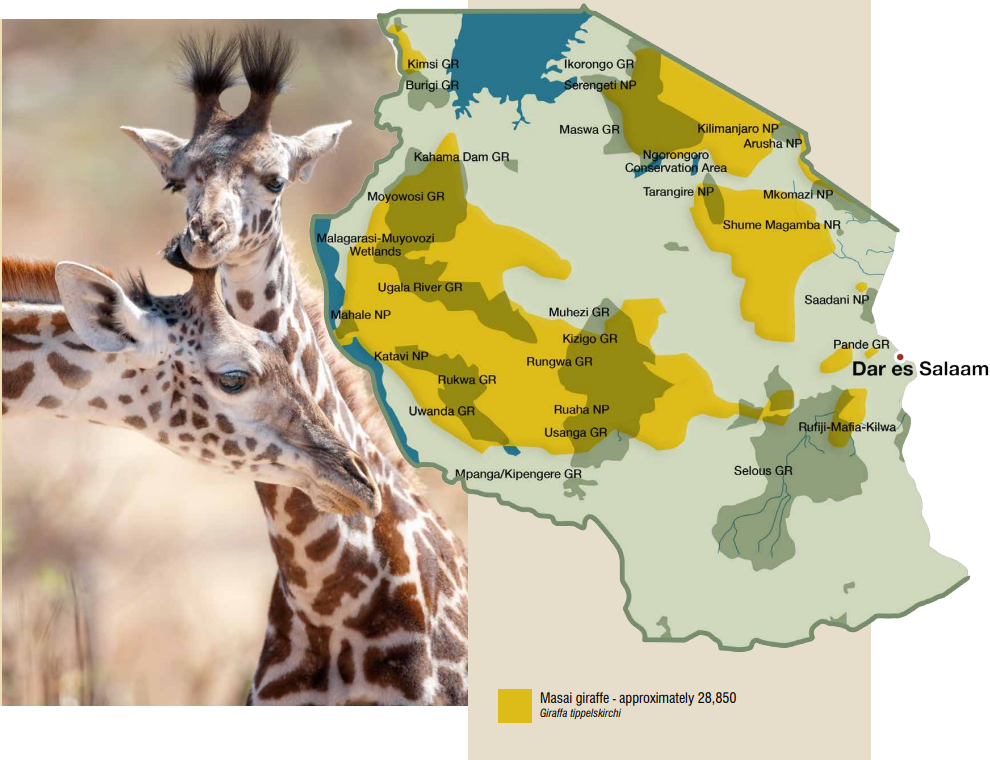
According to Tanzania Wildlife Research Institute (TAWIRI) aerial survey estimates the Masai giraffe population in Tanzania currently stands at approximately 28,850 individuals, though earlier IUCN assessments reported a figure closer to 22,000, indicating a significant decline from about 31,000 in 1986. As a result, the Masai giraffe is listed as Endangered on the IUCN Red List. The population accounts for approximately 30% of the global wild giraffe population, underscoring Tanzania’s critical role in the species’ conservation.
Distribution and Habitat
Masai giraffes are widely distributed across northern, central, and western Tanzania, occupying both protected areas and multiple-use landscapes, including national parks, game reserves, wildlife management areas, and village lands. Notable ecosystems where Masai giraffes are found include the Serengeti, Tarangire-Manyara, Mikumi, Kigosi, and Nyerere National Park, among others (GCF, 2022).
Giraffes in Tanzania inhabit scrublands, open grasslands, and woodlands, browsing on tree species such as Combretum, Commiphora, Vachellia, and Terminalia. They exhibit a fission-fusion social system, and their movement patterns are influenced by forage availability, water sources, and seasonal climatic conditions.
Major Threats
The persistence of Masai giraffe populations is undermined by several interconnected threats:
- Illegal hunting and poaching for bushmeat and body parts (e.g., hides, tails, bones), sometimes linked to unverified traditional medicinal uses (e.g., beliefs about giraffe brain or marrow treating disease).
- Habitat loss and fragmentation due to agricultural expansion, settlement development, and infrastructure projects as well as climate change, which exacerbates habitat degradation.
- Disease prevalence, including Giraffe Skin Disease (GSD) and Giraffe Ear Disease (GED), which affect animal health and mobility.
- Calf predation by carnivores in high-predator-density zones.
- Reduction in food quality and availability, driven by the proliferation of less palatable species like Vachellia robusta.
TRCO’s Approach to Giraffe Research and Conservation
TRCO’s involvement in giraffe conservation is guided by the need for comprehensive ecological data and community-inclusive strategies. The organization’s work is currently focuses on:
- Population assessments to update the current statistics, especially in areas where such information is lacking.
- Threat analyses to understand both ecological pressures and human-induced risks, like illegal hunting and trade of giraffe products.
- Capacity building and community engagement, ensuring local involvement in data collection and protection efforts.
- TRCO conducted giraffe surveys in Saadani National Park in eastern Tanzania and in local communities adjacent to Muyowosi Game Reserve in western Tanzania.
- In 2026, TRCO planned to assess giraffes in Mkomazi National Park and other ecosystems across the country.
Strategic Partnerships
The success of TRCO’s giraffe work is strengthened through collaboration with both national and international institutions. These include:
- Giraffe Conservation Foundation (GCF)
- Tanzania Wildlife Research Institute (TAWIRI)
- Tanzania National Parks Authority (TANAPA)
- Tanzania Wildlife Management Authority (TAWA)
- Local government authorities and community-based conservation organizations
- University of Dar es Salaam (UDSM)
These partnerships ensure that research findings inform policy, management decisions, and conservation planning at multiple scales.
Invitation to Collaborate
To advance giraffe conservation in Tanzania, TRCO seeks to scale up its research and outreach activities. We invite donors, conservation agencies, academic institutions, and private sector partners to collaborate in supporting:
- Field-based ecological research
- Disease surveillance and response
- Community conservation initiatives
- Training programs for local conservation practitioners
With increased investment and coordinated action, Tanzania has the potential to become a regional leader in giraffe conservation. TRCO remains committed to delivering scientifically robust and socially inclusive programs to secure the future of Masai giraffes across their range.
For partnership opportunities or funding support, please contact us via www.trco.or.tz.